
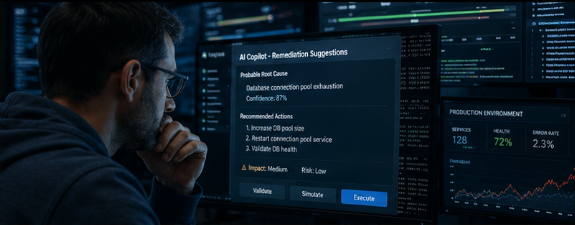
We have spent two years hearing that AI is going to revolutionise IT operations. And in part that is true. But as with any technology hype cycle, there is an inevitable hangover between vendor promises and the harsh reality of an on-call shift at 3 a.m.
Let me be direct: AI is the best copilot we have ever had in IT support. But confusing it with the autopilot can cost you dearly — very dearly.
What AI already does well — and should be leveraged
of mature companies already use AI for anomaly detection — Atlassian State of Incident Management
AI triages, summarises and filters noise with a precision that no human L1 can match at 4 a.m. Before your on-call engineer has finished their coffee, AI will already have:
- Correlated alerts from 12 different sources
- Summarised the incident context in 3 lines
- Identified the most recent relevant deployments
- Suggested the most likely runbook
- Filtered out 80% of alerts that were noise
- Restarting services in production without context
- Escalating tickets to customers with automated messages
- Executing rollbacks without validating dependencies
- Interpreting silence in metrics as "all OK"
- Deciding whether an incident is business-critical
The 44% who know why they keep humans as the last line
of organisations expressly prohibit AI from executing remediation on customer-facing systems — PagerDuty State of Operations 2026
This is not technological distrust. It is basic operational governance. Customer-facing systems carry legal, reputational and contractual consequences that no language model can correctly weigh.
Does AI know that this specific service has an SLA contract with a 20% penalty if it is down for more than 15 minutes? Does it know that this particular customer is in the middle of their annual renewal process and that a mishap today could cost the contract? It does not. You do.
of operations teams do not trust AI to correctly communicate incident status to stakeholders — PagerDuty 2026
And they are right. Communicating an incident is not just transmitting technical data. It is managing perception, expectations and trust. Things AI still stumbles over.
The right model: the human finger always presses Enter
The architecture that works in the most mature teams is consistent: AI diagnoses, proposes and prepares. The human decides, validates and executes.
It is not that the human is smarter than AI at log correlation tasks. AI wins that without argument. But the human has something AI does not: accountability. And accountability has to sit somewhere.
The warning nobody wants to hear
This is where I get serious for a moment.
Teams that treat AI as a threat today are wasting time. Those who adopt it without criteria are accumulating operational risk. The only sensible path is the team that understands what AI does well and where it needs human supervision.
The uncomfortable reality: in 18 months, the AI models that today make mistakes in IT operations will be substantially better than part of current L1 teams. Not in everything, but in triage, correlation and runbook suggestion. The question is not whether AI is going to change the profile of your support team. The question is whether you will be ready when that happens, or whether you will find out too late.
The teams that win are those already redefining roles: less "the one who knows you need to restart service X when Y happens" and more "the one who supervises, validates and continuously improves the systems that do that work".
Have you started sweating yet? If not, I recommend you start soon. The window to adapt calmly is narrowing.
Series: IT Operations Without the Smoke
Is AI already part of your operations? Share your experience on LinkedIn
Share on LinkedInDo you have AI in your operations or only in vendor demos?
We help you design the right architecture: what to automate with AI and where to maintain human control.