
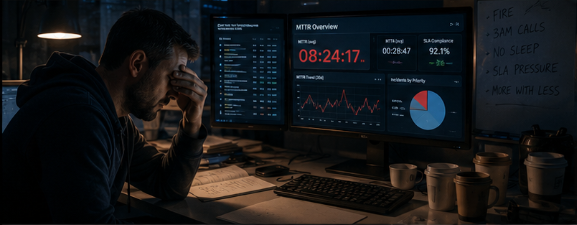
When it comes to IT Service Management (ITSM), there is a toxic addiction to timer-based acronyms: MTTR (Mean Time To Resolve), MTTA (Mean Time To Acknowledge), MTTD (Mean Time To Detect).
Service managers' dashboards are filled with these little numbers in green or red, as if the operations department were a Formula 1 pit lane.
What's the point of shaving an hour off the clock?
What's the point of reducing ticket resolution time from 4 hours to 3 hours if your SLA is 8 hours and the affected system had no users connected at that moment?
I'll tell you: at a business level it's completely pointless, but it carries a brutal hidden cost. To shave that hour off the clock, you probably had to interrupt a Level 2 or Level 3 engineer, pull them out of their flow in a critical project, and generate an unnecessary spike of stress.
There are things that we as managers often forget — the time we need to concentrate and start being productive. Focusing, getting into the work, and then switching context on demand at the sound of a beep on the wall is one of the most unproductive things I've seen in my entire career.
The burnout that doesn't show up in the metrics
Industry average MTTR in working hours — HDI Global Benchmarking
Systematically pushing your team to resolve incidents in 45 minutes only leads to one thing: burnout syndrome — and on top of that, a deep aversion to the very tools they use.
of professionals report that pressure from outages and response times erodes team morale — State of AI-First Operations 2026
The business impact metrics that actually matter
Organisations mature in their IT management when they stop obsessing over the clock and shift to reviewing business impact metrics.
Let's look at Europe: according to recent studies, 36% of organisations in Germany — a country with a relentless efficiency culture — already track "employee working hours lost" as their primary KPI, well above simple server downtime metrics.
A critical incident is not just measured by how quickly a ticket is closed in the ITSM tool. It's measured by how many people couldn't do their actual work — and above all, by how much technical talent you had to burn to fix it.
It's time to stop idolising MTTR and start protecting the teams that keep the lights on.
Series: IT Operations Without the Smoke
Do you recognise this problem in your company? Share it on LinkedIn
Share on LinkedInAre you measuring what matters or what looks good on the dashboard?
We help you redesign your operations metrics so they reflect real business impact.