
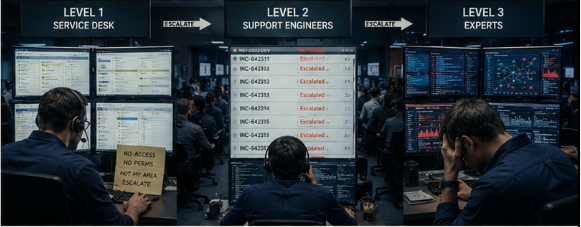
We are all surely familiar with the classic incident resolution flow. Someone — a user, a monitoring tool, an angry customer — detects a problem. Someone else opens a ticket. Level 1 receives it and processes it.
Since the L1 operator has no permissions on the servers, no access to the code, no tools to diagnose the network or absolutely anything else, they simply read the description, classify the urgency — sometimes incorrectly, because users always claim it is "critical" — and pass the ticket to Level 2 or, if someone considers it serious enough, to Level 3.
The real cost: €15 vs €2 per ticket
Maintaining this model today is financial negligence.
Cost per ticket through manual human triage and escalation — ServiceNow
Cost per ticket with automation-guided resolution or self-service
But the real drama is not the cost of the ticket itself — it is the bottleneck it creates in operations and the company's critical talent. Level 2 and Level 3 — systems engineers, senior developers, architects — are high-cost personnel who should be used to build, innovate, and solve complex problems.
If your L1 only acts as a paper-pusher, you are flooding your scarcest talent with noise and false alarms.
The solution: Zero-Touch Automation
The solution is not to hire more people at L1, but to implement Zero-Touch Automation strategies. The goal is for the system alert or user ticket to be automatically classified through Predictive Intelligence before a human touches it.
This topic has many ramifications that we could spend rivers of ink on: we need clear mailboxes and clear ownership, we need to normalise alerts so they have a coherent structure, and we need to define how far automation can go in automatic incident resolution. Normalisation and procedures — that is where things fall apart. Giants with feet of clay, as they say.
When human escalation actually makes sense
The human brain should be reserved for what matters. The PagerDuty 2026 report makes it clear: when an incident affects multiple systems, 43% of companies require mandatory human coordination.
That is the real function of escalation: aligning people to solve complex problems, not acting as switchboard operators passing problems from one queue to another.
A Level 3 engineer's day-to-day should be spent resolving complex architecture failures, not restarting the HR printing service because L1 did not know which category to use in the ticketing tool.
Series: IT Operations Without the Smoke
Is your L1 also a human router? Share it on LinkedIn
Share on LinkedInWant to know how much your current escalation model is costing you?
We analyse your escalation flow and tell you exactly where to automate to free up your L2 and L3.